
Göbekli Tepe and the World’s First Monumental Sanctuary
- hdhdhdhd
- sjsjjsjsjs
- jsjsjjsshgsh
- jdjdjdjdjdj
- djdjdjdjdjd
- jdjdjdjdjdj
For decades, archaeologists believed that humanity only became capable of constructing monumental architecture after the invention of agriculture. According to this long-standing theory, people first settled into permanent villages, cultivated crops, domesticated animals, and gradually developed the social organization necessary to build temples, monuments, and cities. Ancient civilizations such as Egypt, Mesopotamia, and Sumer were considered the pioneers of large-scale construction.
However, an extraordinary archaeological discovery in southeastern Turkey completely transformed that understanding.
Hidden beneath what appeared to be an ordinary hill lay an enormous stone complex dating back nearly 11,600 years—more than 7,000 years older than the Great Pyramids of Giza and approximately 6,000 years older than Stonehenge. Known as Göbekli Tepe, this remarkable site is widely regarded as the world’s oldest known monumental sanctuary. Its discovery forced historians and archaeologists to reconsider one of the most fundamental questions about human civilization: Did agriculture lead to organized religion, or did religious belief inspire people to create settled communities?
Today, Göbekli Tepe remains one of the most fascinating archaeological discoveries ever made. Researchers continue to debate who built it, how massive limestone pillars weighing up to 20 tons were transported without metal tools or the wheel, why the entire complex was deliberately buried thousands of years ago, and what role it played in the lives of prehistoric hunter-gatherers.
This article explores the history of Göbekli Tepe in depth, examining its discovery, architecture, archaeological significance, cultural importance, and the mysteries that continue to captivate scientists and historians around the world.
What Is Göbekli Tepe?
Göbekli Tepe is a prehistoric archaeological site located in Şanlıurfa Province, southeastern Turkey, approximately 15 kilometers (9 miles) northeast of the modern city of Şanlıurfa. The name “Göbekli Tepe” translates from Turkish as “Potbelly Hill” or “Hill with a Navel,” referring to the rounded hill beneath which the ancient structures remained hidden for thousands of years.
The site dates to the Pre-Pottery Neolithic A (PPNA) period, roughly between 9600 BCE and 8200 BCE, placing it at the very beginning of the Neolithic era. This was a time when humans were still primarily hunter-gatherers, long before the emergence of writing, metallurgy, organized kingdoms, or even widespread farming.
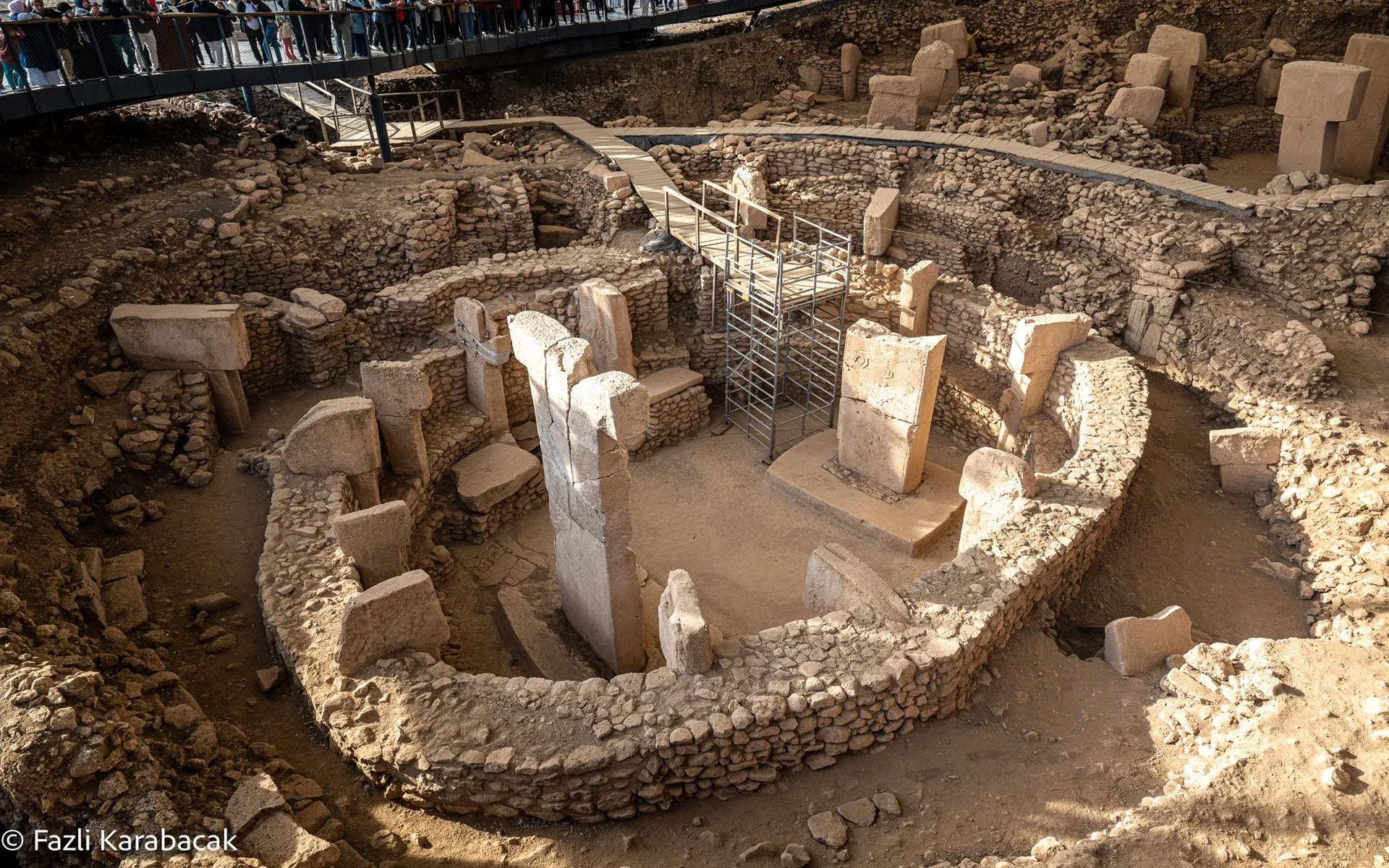
What makes Göbekli Tepe extraordinary is not only its incredible age but also the sophistication of its construction. The site consists of multiple circular and oval stone enclosures built around enormous T-shaped limestone pillars. Some of these pillars stand over 5.5 meters (18 feet) tall and weigh between 10 and 20 tons. Many are decorated with intricate carvings depicting wild animals such as foxes, snakes, boars, lions, gazelles, vultures, cranes, scorpions, and various abstract symbols whose meanings remain uncertain.
Unlike later Neolithic settlements, Göbekli Tepe shows little evidence of permanent residential life. Archaeologists have found no clear signs of houses, domestic kitchens, or everyday living spaces within the monumental enclosures. Instead, the site appears to have been constructed specifically for ceremonial, ritualistic, or communal gatherings, making it fundamentally different from traditional villages of the period.
This discovery challenged one of archaeology’s most established theories. Rather than agriculture creating civilization first, Göbekli Tepe suggests that large-scale religious or ceremonial activities may have encouraged different groups of hunter-gatherers to cooperate, settle together, and eventually develop agriculture to sustain growing populations.
A Strategic Location in the Fertile Crescent
Göbekli Tepe occupies a commanding position within the Fertile Crescent, a region stretching across parts of modern-day Turkey, Syria, Iraq, Iran, Lebanon, Jordan, Israel, and Palestine. Often referred to as the “Cradle of Civilization,” this area witnessed some of humanity’s earliest developments in agriculture, animal domestication, and permanent settlement.
The sanctuary was constructed on top of a limestone ridge overlooking an expansive landscape of rolling hills and fertile plains. From its elevated position, visitors would have enjoyed panoramic views extending for many kilometers in every direction. Such visibility may have made Göbekli Tepe an ideal gathering place for numerous hunter-gatherer communities spread throughout the surrounding region.
The local environment also provided abundant natural resources. High-quality limestone was readily available and could be quarried directly from the bedrock beneath the site. Archaeologists have identified several ancient quarries where enormous stone blocks were extracted before being shaped into the iconic T-shaped pillars.
Ten thousand years ago, the surrounding landscape looked very different from today. It supported vast herds of wild gazelles, wild cattle (aurochs), wild donkeys, deer, and numerous bird species. Seasonal streams supplied fresh water, while forests of pistachio, almond, and oak trees offered additional food resources. This rich environment enabled hunter-gatherers to sustain relatively large populations even before agriculture became widespread.
The strategic location of Göbekli Tepe likely made it an important meeting point where different groups could gather for ceremonies, exchange knowledge, strengthen social relationships, and perhaps participate in seasonal rituals that reinforced shared cultural beliefs.
The Discovery That Changed Human History
Although Göbekli Tepe is now recognized as one of the most significant archaeological discoveries of the modern era, the site remained hidden beneath an artificial mound for thousands of years. To anyone passing by, it appeared to be nothing more than a natural hill rising above the surrounding plains of southeastern Turkey.
The first documented survey of the hill took place in 1963, when a joint archaeological project conducted by researchers from Istanbul University and the University of Chicago visited the area. During their survey, the team noticed numerous fragments of worked limestone scattered across the surface. They also observed several partially exposed stone slabs that appeared to have been shaped by human hands.
Despite these intriguing findings, the site was mistakenly identified as a medieval cemetery. The visible stones were believed to be simple gravemarkers, and the hill received little archaeological attention for the next three decades. At the time, few researchers imagined that an extraordinary prehistoric monument lay buried just beneath the surface.
This initial misinterpretation delayed one of archaeology’s greatest discoveries. Had the site been excavated immediately, the understanding of early human civilization might have changed decades earlier.
Klaus Schmidt and the Beginning of Modern Excavations
Everything changed in 1994, when German archaeologist Klaus Schmidt of the German Archaeological Institute visited the hill after reviewing the earlier survey reports. Schmidt immediately recognized that the large limestone fragments visible on the surface did not resemble gravestones. Instead, they appeared to be prehistoric megaliths similar to those found at nearby Neolithic settlements, but on a much larger scale.
Convinced that the mound concealed something extraordinary, Schmidt launched systematic excavations in 1995 in collaboration with the Şanlıurfa Museum.
Almost immediately, archaeologists uncovered enormous T-shaped limestone pillars arranged in carefully planned circular enclosures. As excavation continued, more pillars emerged, many decorated with remarkably detailed carvings of animals and abstract symbols unlike anything previously discovered from such an early period.
Radiocarbon dating soon revealed an astonishing fact.
The oldest structures had been constructed around 9600 BCE, making them the oldest known monumental architecture ever discovered.
This date stunned the archaeological community.
Until then, researchers believed that monumental religious architecture first appeared several thousand years later, after farming societies had already become established. Göbekli Tepe demonstrated that hunter-gatherers had organized massive construction projects thousands of years before the invention of pottery, writing, bronze tools, or cities.
Schmidt devoted the remainder of his career to studying the site until his death in 2014. Today, he is widely credited with bringing Göbekli Tepe to international attention and fundamentally reshaping our understanding of prehistoric societies.
Rewriting the Story of Civilization
Before the discovery of Göbekli Tepe, the prevailing model of human development appeared straightforward.
According to conventional theory, the sequence of civilization unfolded in the following order:
- Humans adopted agriculture.
- Permanent villages were established.
- Food surpluses supported population growth.
- Specialized labor emerged.
- Organized religion developed.
- Monumental temples and ceremonial structures were built.
This progression suggested that religion was a consequence of settled agricultural life.
Göbekli Tepe challenged nearly every step of this sequence.
The site demonstrated that highly organized construction projects were already taking place while people still relied primarily on hunting and gathering. Hundreds of individuals would have been required to quarry limestone, transport pillars weighing up to 20 tons, carve intricate reliefs, and arrange the stones into precisely planned ceremonial enclosures.
Such an undertaking implies sophisticated planning, leadership, cooperation, and shared beliefs.
As a result, many archaeologists proposed a revolutionary alternative theory:
Rather than agriculture creating religion, religion may have encouraged agriculture.
If large numbers of people regularly gathered at Göbekli Tepe for rituals or seasonal ceremonies, they would have required reliable food supplies. Producing enough food for these gatherings may have encouraged experimentation with cultivating wild cereals and eventually led to the domestication of plants.
Although this hypothesis remains debated, it has become one of the most influential ideas in modern archaeology.
How Large Is Göbekli Tepe?
One of the most surprising aspects of Göbekli Tepe is that only a small fraction of the site has been excavated.
Geophysical surveys using ground-penetrating radar and magnetic imaging indicate that the archaeological mound covers approximately 22 acres (9 hectares) and contains numerous buried structures extending well beyond the currently excavated areas.
To date, archaeologists have uncovered only about 5–10% of the entire complex.
This means that the overwhelming majority of Göbekli Tepe remains hidden beneath the earth, preserving invaluable archaeological evidence for future generations and allowing researchers to study the site using increasingly advanced technologies.
The excavated portions have revealed several large circular and oval enclosures, each built around pairs of massive central pillars surrounded by smaller stone pillars connected by low stone walls.
The layout suggests careful architectural planning rather than random construction. Every enclosure appears to follow a consistent design, indicating that the builders possessed established construction techniques and shared symbolic traditions.
The possibility that dozens of additional ceremonial structures remain buried has fueled enormous excitement within the archaeological community. Each new excavation season has the potential to reveal previously unknown carvings, architectural features, or evidence that could reshape current interpretations of the site.
Why Was Göbekli Tepe Buried?
Perhaps the greatest mystery surrounding Göbekli Tepe is not how it was built—but why it disappeared.
Unlike many ancient monuments that gradually collapsed through erosion, warfare, or natural disasters, Göbekli Tepe appears to have been deliberately buried.
Around 8000 BCE, the builders intentionally filled the monumental enclosures with massive quantities of limestone rubble, broken tools, animal bones, soil, and other debris. The filling material was carefully deposited until the structures were completely covered, creating the artificial hill that preserved the sanctuary for thousands of years.
This deliberate burial required an extraordinary amount of labor—possibly as much effort as constructing the site itself.
Why would a society invest centuries building one of humanity’s earliest monumental sanctuaries only to intentionally conceal it?
No definitive answer exists, but archaeologists have proposed several possibilities.
One theory suggests that the burial represented a ritual act marking the end of the sanctuary’s sacred use. Rather than abandoning a holy place to decay, its builders may have intentionally sealed it as part of a ceremonial tradition.
Another possibility is that changing religious beliefs made the older sanctuary obsolete. As agriculture spread and permanent settlements developed across the region, ceremonial practices may have evolved, leading communities to construct new ritual centers while respectfully burying older ones.
Some researchers also argue that environmental or social changes—including shifts in population, climate, or available resources—may have contributed to the site’s abandonment.
Whatever the reason, the decision to bury Göbekli Tepe inadvertently created one of archaeology’s greatest time capsules. Protected beneath layers of earth for nearly ten millennia, its stone carvings remained remarkably well preserved, allowing modern researchers to study details that would otherwise have been lost to weathering and erosion.
The mystery of its intentional burial continues to be one of the most compelling questions surrounding Göbekli Tepe and remains an active area of archaeological research.
The Architecture of Göbekli Tepe: A Masterpiece of Prehistoric Engineering
One of the most remarkable aspects of Göbekli Tepe is its architecture. Built more than 11,000 years ago, the sanctuary demonstrates a level of planning, engineering, and craftsmanship that few archaeologists believed possible for hunter-gatherer societies.
Unlike later temples made of mudbrick or wood, Göbekli Tepe was constructed almost entirely from limestone. Massive stone pillars, carefully carved and arranged into circular enclosures, formed the heart of the complex. The precision of the construction suggests that its builders possessed advanced knowledge of stoneworking and architectural planning despite living thousands of years before the invention of metal tools.
Each excavated enclosure follows a similar design. Large T-shaped pillars stand at the center, surrounded by a ring of smaller pillars connected by low stone walls. The symmetrical layout indicates that these structures were not built randomly over time but according to carefully planned architectural principles.
The repetition of this design throughout the site also implies the existence of shared construction techniques, cultural traditions, and possibly specialized builders who passed their knowledge from one generation to the next.
The Mysterious T-Shaped Pillars
The defining feature of Göbekli Tepe is its enormous T-shaped limestone pillars.
These monolithic stones range from approximately 3 to 5.5 meters (10–18 feet) in height and weigh between 10 and 20 tons, with some unfinished stones in nearby quarries estimated to exceed 50 tons.
Each enclosure typically contains two larger pillars standing opposite one another in the center, while smaller pillars form a surrounding ring. This arrangement appears to have been intentional and repeated consistently throughout the sanctuary.
Although the pillars may appear simple at first glance, closer examination reveals remarkable craftsmanship.
Many feature carved arms extending along their sides, with hands meeting at the front. Some display belts, loincloths, or decorative pendants. These details strongly suggest that the pillars were intended to represent stylized human figures rather than ordinary architectural supports.
Interestingly, no faces are carved on the pillars. Instead, the horizontal top of the “T” may symbolize the head, creating an abstract human form. This minimalist design has led researchers to speculate that the pillars represented ancestors, deities, spiritual beings, or revered community leaders.
The two central pillars within each enclosure are noticeably larger than the surrounding ones, reinforcing the idea that they held special symbolic or ceremonial significance.
Extraordinary Stone-Carving Techniques
Creating the pillars required an impressive understanding of quarrying and stoneworking.
The builders first identified suitable limestone outcrops directly beneath the hill. Using stone hammers made from harder rocks such as basalt, they carved trenches around the desired blocks before separating them from the bedrock.
Once detached, the pillars were shaped using repeated hammering and grinding techniques. Every edge had to be carefully smoothed, while relief carvings demanded exceptional precision.
Considering that metal chisels would not be invented for several thousand years, the quality of the carvings is astonishing.
Some animal figures display subtle anatomical details, including muscle contours, claws, feathers, tails, and facial expressions. These features demonstrate not only artistic ability but also close observation of the natural world.
The builders invested an enormous amount of time into each pillar, suggesting that the sanctuary was created over many generations rather than in a single construction phase.
Transporting Stones Without the Wheel
Perhaps the greatest engineering mystery is how prehistoric people transported pillars weighing up to 20 tons without wheeled vehicles, domesticated draft animals, or metal machinery.
Several theories have been proposed.
The most widely accepted explanation suggests that teams of workers dragged the pillars across the ground using wooden sledges, ropes made from plant fibers or animal hides, and lubricated pathways that reduced friction.
Others propose that wooden rollers were placed beneath the sledges, although direct archaeological evidence remains limited.
Experimental archaeology has shown that hundreds of people working together can move extremely heavy stones using simple tools when movements are carefully coordinated.
The relatively short distance between the limestone quarries and the ceremonial enclosures—often only a few hundred meters—would also have made transportation more manageable.
Even so, moving dozens of enormous pillars would have required exceptional organization, planning, leadership, and cooperation among large groups of people.
The Animal Reliefs
The stone carvings at Göbekli Tepe represent one of the oldest known examples of monumental sculpture.
Unlike later civilizations that often depicted kings or gods, Göbekli Tepe’s artists focused primarily on animals.
Among the species identified are:
- Foxes
- Snakes
- Wild boars
- Aurochs (wild cattle)
- Gazelles
- Lions
- Leopards
- Scorpions
- Cranes
- Ducks
- Vultures
- Wild donkeys
- Insects
- Spiders
Many animals appear individually, while others are shown interacting in dynamic scenes.
Some predators seem to stalk prey, while snakes twist around the pillars in striking compositions. Several reliefs project outward in high relief, giving them a three-dimensional appearance rarely seen in prehistoric art.
The exceptional realism suggests that the artists possessed intimate knowledge of local wildlife.
These animals were not randomly selected. Many were among the most dangerous creatures inhabiting the region during the early Neolithic period, leading researchers to believe they held symbolic, spiritual, or mythological significance.
Symbols That Remain Undeciphered
In addition to animals, many pillars contain mysterious geometric symbols.
These include:
- H-shaped motifs
- Crescent-like figures
- Circles
- Parallel lines
- Zigzags
- Abstract marks
- Stylized belts
- Hand symbols
Unlike written language, these symbols do not form readable texts.
Nevertheless, some archaeologists believe they may represent one of humanity’s earliest systems of symbolic communication.
Certain symbols appear repeatedly throughout different enclosures, suggesting they carried shared meanings understood by the communities that gathered there.
Whether they represented clans, spiritual concepts, celestial objects, seasonal events, or ritual instructions remains unknown.
Because no written records survive from this period, interpreting these symbols remains one of archaeology’s greatest challenges.
Were the Enclosures Roofed?
One long-standing debate concerns whether Göbekli Tepe’s monumental enclosures were open to the sky or protected by roofs.
Some researchers argue that the structures were entirely open-air sanctuaries, allowing ceremonies to take place beneath the sun, moon, and stars.
Others suggest that wooden beams supported lightweight roofs made from branches, reeds, or animal hides.
Evidence exists for both possibilities.
Stone sockets and architectural features may indicate support structures for roofing materials. On the other hand, no preserved roof remains have been discovered, largely because organic materials decompose over thousands of years.
If roofs once existed, they were almost certainly constructed from perishable materials that disappeared long ago.
The question remains unresolved and continues to inspire archaeological investigation.
Engineering Beyond Expectations
Perhaps the most astonishing aspect of Göbekli Tepe is the level of organization required to construct it.
Building even a single enclosure would have involved:
- Selecting suitable limestone.
- Quarrying massive stone blocks.
- Carving dozens of pillars.
- Transporting stones weighing several tons.
- Digging deep foundation pits.
- Precisely positioning each pillar.
- Constructing surrounding walls.
- Decorating the surfaces with elaborate reliefs.
Completing these tasks without metal tools, wheeled transport, or domesticated work animals required remarkable coordination.
Many researchers estimate that hundreds of people may have participated in the construction of individual enclosures, working together over extended periods.
Such cooperation suggests the existence of complex social structures capable of organizing large communal projects long before cities, kingdoms, or formal governments emerged.
Göbekli Tepe demonstrates that prehistoric hunter-gatherers were far more sophisticated than previously believed. Rather than living in small, isolated bands with limited abilities, they possessed the organizational skills, artistic talent, engineering knowledge, and shared cultural traditions necessary to create one of humanity’s earliest—and most extraordinary—monumental sanctuaries.
By redefining what was possible during the dawn of civilization, Göbekli Tepe continues to challenge our assumptions about the origins of architecture, religion, and complex human society.